
Friday, 4 September 2026, 15:00 CET
The POP project has been promoting best practices in the performance analysis of HPC applications, which have traditionally focused on scientific and engineering applications. The project's objective has been to raise awareness among users and code developers of how efficiently their applications use hardware resources, with the potential to influence code refactoring or job configuration settings to improve efficiency. AI has emerged as an even greater consumer of computing power, prompting the question of how efficiently resources are used in this context.
The two worlds originated and evolved relatively independently, paying little attention to each other. The terminology used in each field is such that the same words (e.g. architecture, task, performance) refer to very different concepts. Although deeply rooted in the HPC domain, at POP we have made efforts to apply HPC tools and methodologies to the AI world. This talk will describe our experiences of this transition and explain how we have reached a point where we can carry out very detailed analyses of AI application execution and provide more insight into actual performance ('HPC performance') than application developers or users often have.
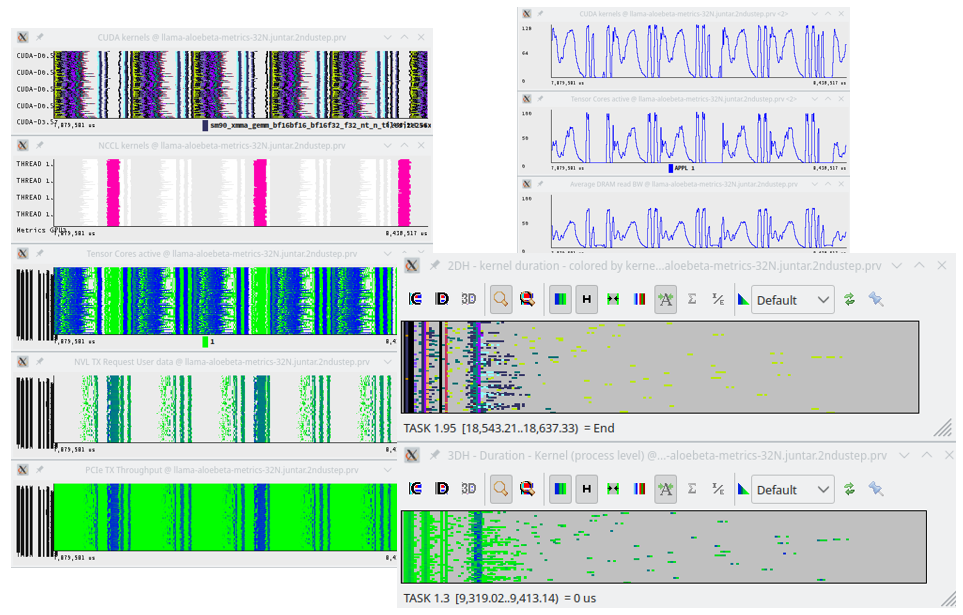
The analysis framework is based on translating Nsight Systems traces to Paraver, which significantly improves the scale and analysis capability of the captured data. I will give some examples of initial experiences and consider the 'common wisdom' regarding the characteristics or needs of accelerated AI systems, as well as providing examples of how precise insight can be used to inform the configuration of applications or adaptations within the framework.
About the Presenter
 Prof. Jesús Labarta received his Ph.D. in Telecommunications Engineering from UPC in 1983, where he has been a full professor of Computer Architecture since 1990. He was Director of European Center of Parallelism at Barcelona from 1996 to the creation of BSC in 2005, where he is the Director of the Computer Sciences Dept. His research team has developed performance analysis and prediction tools and pioneering research on how to increase the intelligence embedded in these performance tools. He has also led the development of OmpSs and influenced the task based extension in the OpenMP standard. He has led the BSC cooperation with many IT companies. He is now responsible for the POP center of excellence, providing performance assessments to parallel code developers throughout the EU, and leads the RISC-V vector accelerator within the EPI project. He has pioneered the use of Artificial Intelligence in performance tools and will promote their use in POP, as well as the AI-centric co-designing of architectures and runtime systems. He was awarded the 2017 Ken Kennedy Award for his seminal contributions to programming models and performance analysis tools for high performance computing, being the first non-US researcher to receive it.